Rilke Trail Trieste Italy: The Clifftop Path from Duino to Sistiana
The Rilke Trail is the clifftop path that runs along the limestone coast between Duino and Sistiana north of Trieste, Italy, named for the poet Rainer Maria Rilke, who wrote part of his Duino Elegies at the castle above it.
Short answer
The Rilke Trail is a coastal clifftop path near Trieste, Italy, running between Duino and Sistiana above the Gulf of Trieste. It is free to walk, reachable from Trieste by regional transport, and usually combined with Duino Castle and Miramare Castle.
The Rilke Trail is a clifftop path on the limestone coast north of Trieste, Italy, running above the Gulf of Trieste between Duino and Sistiana in the Friuli Venezia Giulia region. It is named after the Prague-born poet Rainer Maria Rilke, who stayed at Duino Castle in the early years of the twentieth century and began the Duino Elegies there, and it has become one of the most walked stretches of coastline in the province. The path itself is free, open year-round, and looks straight down onto some of the clearest water on the northern Adriatic. This guide covers what the trail is, how to reach it from the city, what you will see, when to walk it, and what to combine it with, including the castles at either end and the sea-level view of the same cliffs from a kayak.
What Is the Rilke Trail Near Trieste, Italy?
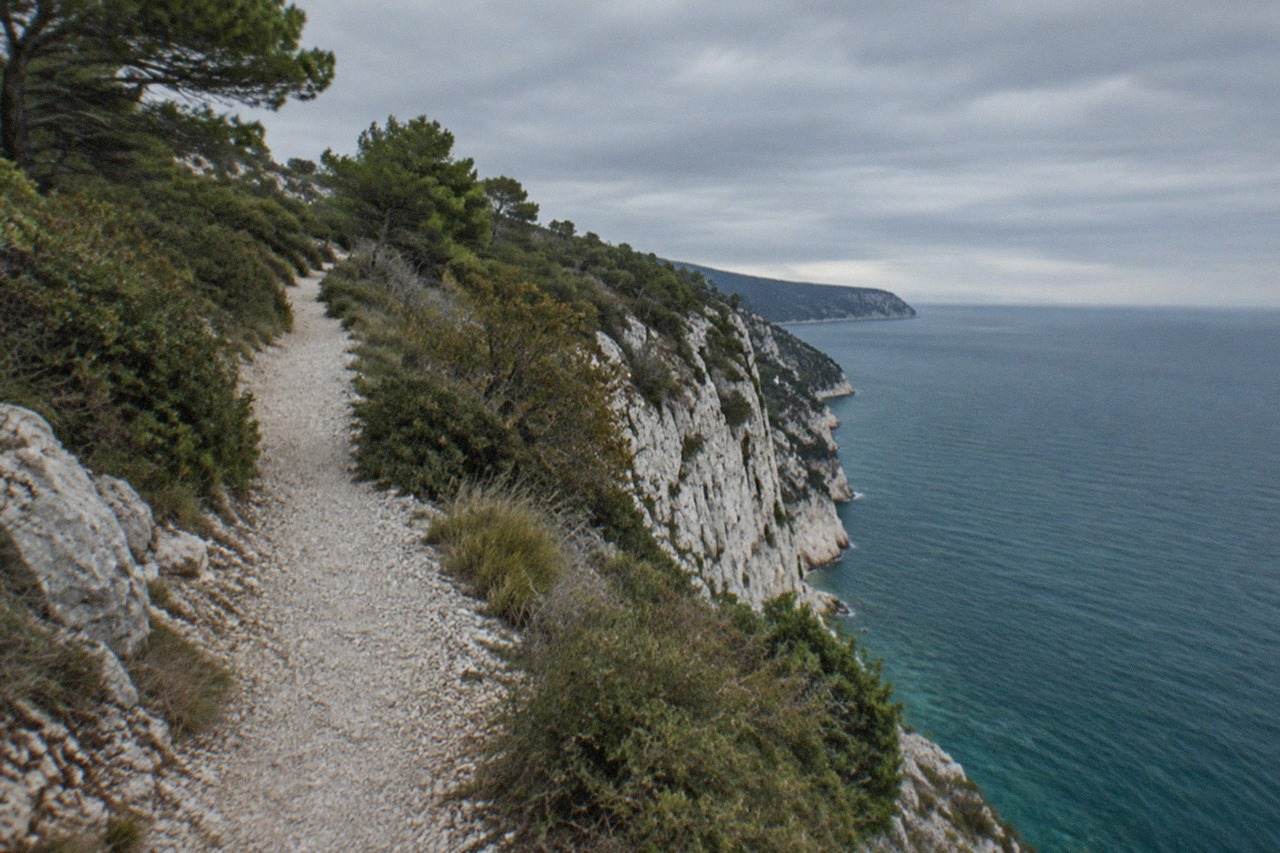
The Rilke Trail is a marked clifftop footpath on the Karst coastline between Duino and Sistiana, north of Trieste in northern Italy, following the white limestone cliffs above the Gulf of Trieste. It is free to walk, has no ticket, no gate and no opening hours, and it takes its name from the poet Rainer Maria Rilke, who stayed repeatedly at Duino Castle and wrote the opening lines of the Duino Elegies there in the years before and after the First World War.
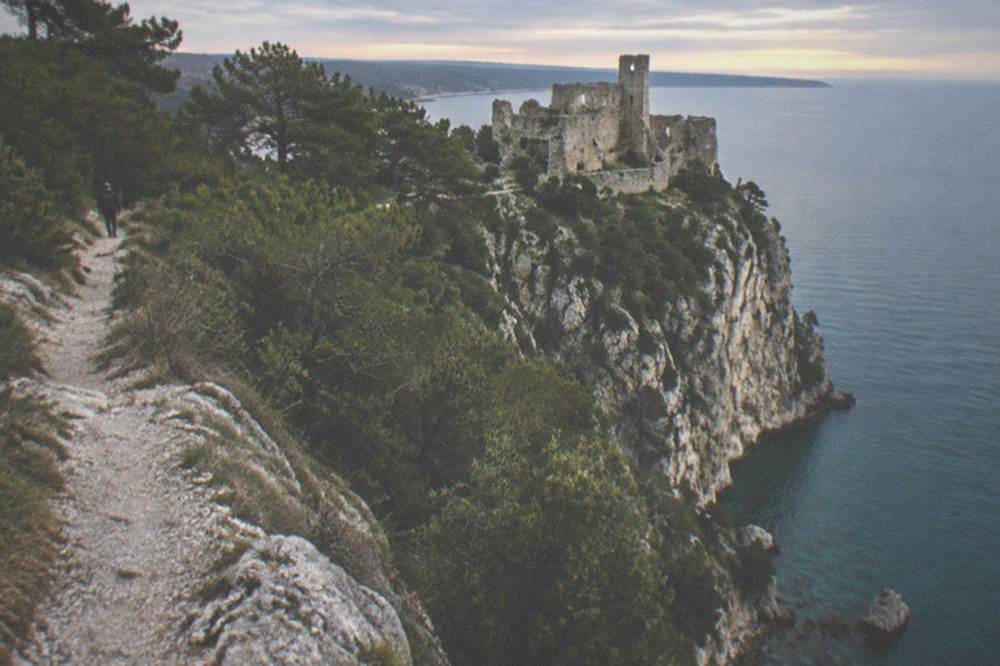
The path is the single best place to understand what the coast north of Trieste actually is. The city itself sits on a shallow shelf at the foot of the Karst plateau, and the plateau does not fade out politely at the shoreline: it drops into the sea as a cliff line. The Rilke Trail runs along the top of that drop, through scrub, low holm oak and karst grassland, with the water directly below. On clear days the view runs across the gulf towards Molo Audace and the Victory Lighthouse at one end of the horizon and down the Istrian coast at the other.
The name is not marketing. Rilke arrived at Duino Castle as a guest of Princess Maria von Thurn und Taxis, walked this same stretch of coast, and later described the sea and the cliffs in letters. When the trail was formally named and signed, it was named for him, and the connection is why walkers arrive here from German-speaking Europe as much as from Italy. The poet's presence is also why the trail is usually described as a literary walk as much as a scenic one: you are following a documented path of a specific poet, not a generic coastal promenade.
It is worth being clear about what the trail is not. It is not a beach path, it is not paved like the Barcola seafront, and it is not a loop: it connects two points on the coast, Duino and Sistiana, and most walkers do one direction and return by transport or on the same path. The underlying rock is the same Karst limestone that shapes the whole region, the same stone that hollows out into Grotta Gigante inland and holds the terraced vineyards where the Carso's own wines, Vitovska, Malvasia and Terrano, are grown.
How Do You Get to the Rilke Trail from Trieste?
You reach the Rilke Trail from Trieste by heading up the coast to Duino, where the trail's southern trailhead sits beside Duino Castle, or to Sistiana at the northern end. Trieste's urban network, regional buses and the airport's intermodal hub all serve the Duino-Aurisina area, a standard urban ticket covers Trieste Trasporti's city lines, and the trail itself starts a short walk from the castle. Check the operator's route planner for the current timetable rather than relying on a printed one.
The practical starting point for almost everyone is Duino, because that is where the castle, the bus stops and the trail's most photographed stretch converge. From central Trieste, the journey runs north along the coast road; do not plan it around a specific frequency or journey time printed here, because timetables change and this page will not be the first thing updated. Trieste Trasporti publishes its current fares and route information on its own site, and the 2026 urban tariff sheet lists the fares below for travel inside the city network.
| Code | Ticket | Price | Validity |
|---|---|---|---|
| U01 | Urban single | €1.50 | 60 minutes |
| U02 | Urban single | €1.85 | 75 minutes |
| U24 | Day ticket | €3.35 | Full day |
| U10 | 10 rides | €13.50 | Carnet |
| U20 | 20 rides | €16.65 | Carnet |
Single tickets are valid for 60 or 75 minutes, extended to 240 minutes on Sundays and public holidays, and contactless bank cards can be tapped on board the vehicles equipped with "Eva" readers. If you are staying in the city a few days and plan to use the buses more than twice, the day ticket is the one most visitors end up wishing they had bought at the start.
Two other approaches are worth knowing about. Arriving by air, Trieste Airport's station is joined to the terminal by a covered walkway of roughly 400 metres with moving walkways, and the airport's intermodal hub beside the terminal carries the regional bus lines; Duino sits between the airport and the city on the coastal corridor. Arriving from the sea side, the alternative is to see the cliffs from below: the kayak tour that paddles the Duino coast launches from the water and gives you the cliff face, the two castles and the gulf from sea level rather than from the clifftop. Check availability on the operator's live listing if the sea-level version appeals.
For planning the whole day rather than just the transport, the site's Duino and Rilke Trail day trip guide lays out a full itinerary from Trieste, including where the walk fits around lunch and the castles.
What Can You See and Do Along the Rilke Trail?
The Rilke Trail's highlights are Duino Castle at the southern end, the old castle ruins on the cliff top, the white limestone cliffs and coves directly below the path, the views back across the Gulf of Trieste towards the city and the Victory Lighthouse, and Sistiana bay at the northern end, with Miramare Castle and its free park a short way back down the coast towards Trieste.
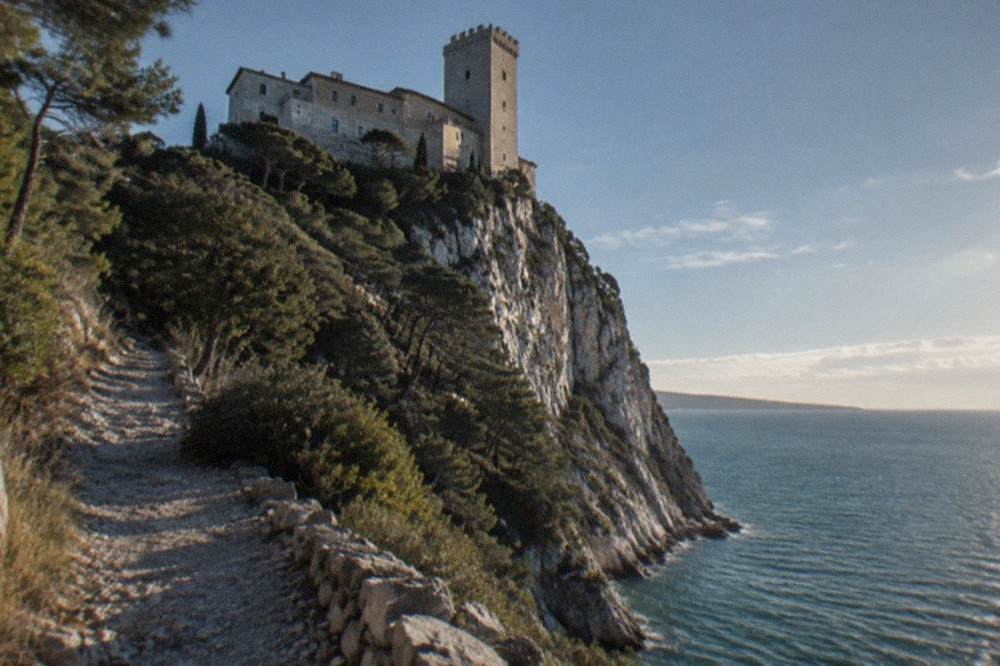
Start at Duino and the castle dominates immediately. Duino Castle is the residence where Rilke was a guest, still privately owned and still inhabited, standing on a cliff spur with the sea on two sides. The path then runs north along the cliff line, past the ruins of the older castle, which sit directly on the rock above the water and are the trail's most recognisable silhouette. Below the path the limestone drops steeply to small coves that are visible but, on most of the stretch, not accessible from the trail itself; the path is a cliff walk, and swimmers generally head for the beaches at Sistiana bay or back towards Barcola rather than the rocks below.
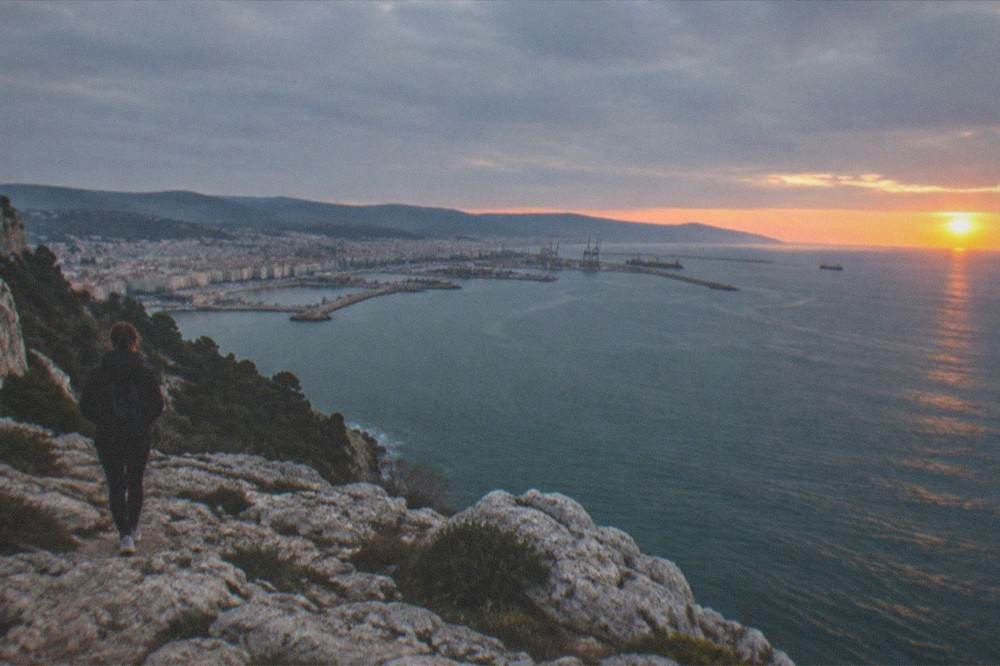
The view is the reason most people come. Looking south, the Gulf of Trieste opens towards the city, with the lighthouse and the horizon of the Rive seafront readable on clear days. Looking down, the water along this coast is unusually transparent because the Karst rivers feed it and the shoreline drops away quickly. Looking inland, the plateau rises into the terraced vineyards and farmhouses of the Carso, the same landscape that produces the osmize, the seasonal farm cellars where growers sell their own wine, signposted by a frasca, a leafy branch hung at the turning. The osmize opening calendar is published at osmize.com and is worth a look before any walk in spring or autumn.
The kayak option deserves its own word. The listing describes a three-hour paddle beneath the Duino castles along this same stretch of coast, priced from $76.81 per person and rated 4.89 from 11 reviews on the operator's listing. It is the only way on this page to see the cliff face of the Rilke Trail from the water, and for anyone who finds clifftop walking hard on the knees it delivers the same scenery with none of the elevation change.
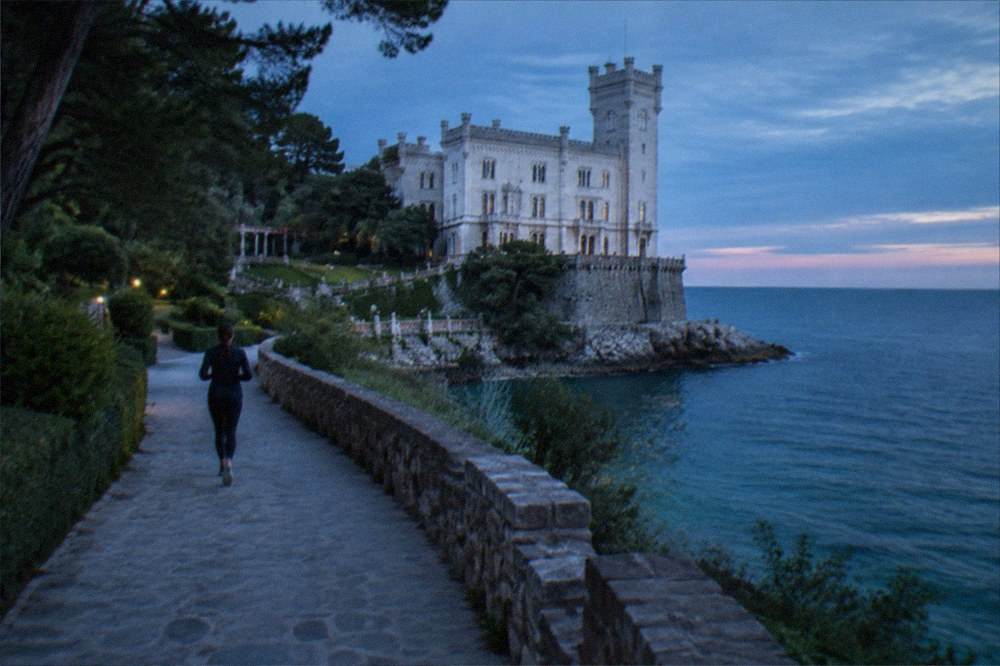
Miramare is the natural third act. The castle and its park sit back down the coast towards Trieste, and the park is free all year, which makes it the cheapest way to extend the day even if you skip the castle interior. The castle itself is a state museum, adult entry €17 including the temporary exhibition, open every day 9:00-19:00 with the ticket office closing at 18:30. A combined ticket with an audio app is also sold through the operator's live listing, from $20.64 per person, rated 4.35 from 881 reviews.
Which Season Is Best for Walking the Rilke Trail?
The best months to walk the Rilke Trail are April, May, June and September, when Trieste's coastal temperatures are mild, the sea is warming, and the bora wind is at its least persistent; July and August are the hottest and busiest but perfectly walkable early in the day, while November is the wettest month at 109.8 mm of rain and the winter months bring the strongest and most frequent bora gusts.
The climate record for Trieste, from ARPA FVG's own station tables at the molo Fratelli Bandiera, gives a precise picture of what each season does to a clifftop walk. The two numbers that matter most are rainfall, because the trail's stone and gravel get slippery when wet, and wind, because the bora blows hardest on exactly this exposed coast.
| Month | Mean high | Rain mm | Sea temperature | Days gusting over 90 km/h |
|---|---|---|---|---|
| April | 16.8 C | 60.7 | 14.0 C | 0.7 |
| May | 21.7 C | 75.0 | 17.9 C | 0.7 |
| June | 25.8 C | 62.5 | 23.1 C | 0.3 |
| July | 28.2 C | 53.8 | 25.9 C | 0.9 |
| September | 23.9 C | 102.3 | 23.9 C | 1.1 |
| November | 14.7 C | 109.8 | 16.8 C | 1.9 |
Read the table the way a walker would. June is statistically the calmest month of the year on this coast, with an average of just 0.3 days of gusts over 90 km/h, and the sea has already reached 23.1 C, so a swim at Sistiana afterwards is realistic. July is the second driest month of the whole year at 53.8 mm of rain, a fact that surprises visitors who assume an Adriatic city is a summer rain trap, but it is also among the hottest, with an average of 7.2 days over 30 C. September is warmer in the water than June, 23.9 C against 23.1 C, because the sea holds its summer heat through the lag, even as the first autumn rains arrive, 102.3 mm across 7.4 wet days.
November is the month to plan around. It is the wettest of the year at 109.8 mm across 9.5 wet days, and the bora season is building: February, the statistical peak of the wind, averages 2.9 days of gusts over 90 km/h and holds the all-time series record, 168.1 km/h in February 2012. None of this makes winter walking impossible, but it makes it a different activity: check the forecast, dress for the wind, and treat the cliff edge with the respect an offshore gust deserves.
Why Is the Trail Named After Rainer Maria Rilke?
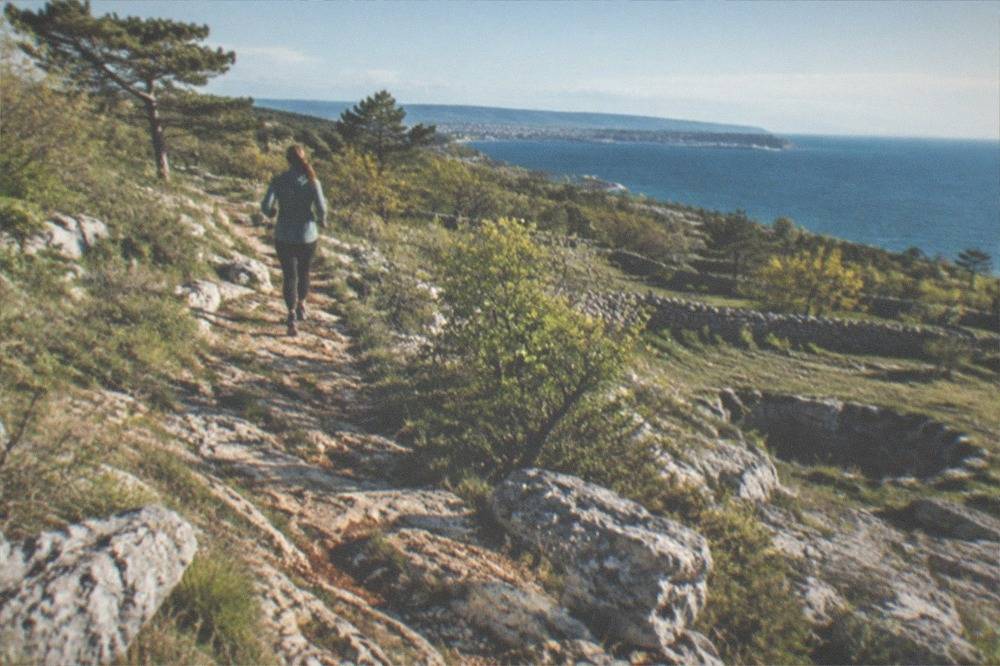
The Rilke Trail is named after Rainer Maria Rilke because the poet stayed at Duino Castle as a guest of Princess Maria von Thurn und Taxis across several visits in the early twentieth century, walked this stretch of coast repeatedly, and began the Duino Elegies there, one of the most influential poetry cycles of the twentieth century, reportedly hearing the famous opening line while walking near the castle walls above the sea.
The story is unusually well documented for a place-name. Rilke, born in Prague and living mostly between Munich, Paris and Vienna, was invited to Duino by the princess, who was a patron and a correspondent. He stayed at the castle over several winters, and it was there that the first elegies of the ten he would eventually finish took shape. He described the coast, the wind and the castle's position above the water in letters written from Duino, and the completed Duino Elegies were published after a long interruption that included the First World War and his years in Switzerland. The wider set of guides lives on Trieste Travel Guide.
What makes the naming more than a plaque is that the landscape is legibly present in the poems. The elegies open with an anguished cry that Rilke said came to him as he walked by the sea below the castle, and the whole cycle is saturated with the imagery of an exposed edge between land and water, cliff and open sea. Walkers who know the poems arrive expecting to find the atmosphere of the text, and the trail delivers it: the wind, the drop, the white rock and the wide gulf are all still exactly where he left them.
The Duino connection is also the reason the area draws a specific kind of visitor. German-language literary tourism is a real presence here, and the castle and the trail together are treated in that world much as a writer's house museum is elsewhere. For everyone else, the practical upshot is that the trail is well signed, well maintained and taken seriously by the local authorities, because it carries a cultural designation that a purely scenic path would not.
Is the Rilke Trail Right for Casual Walkers and Families?
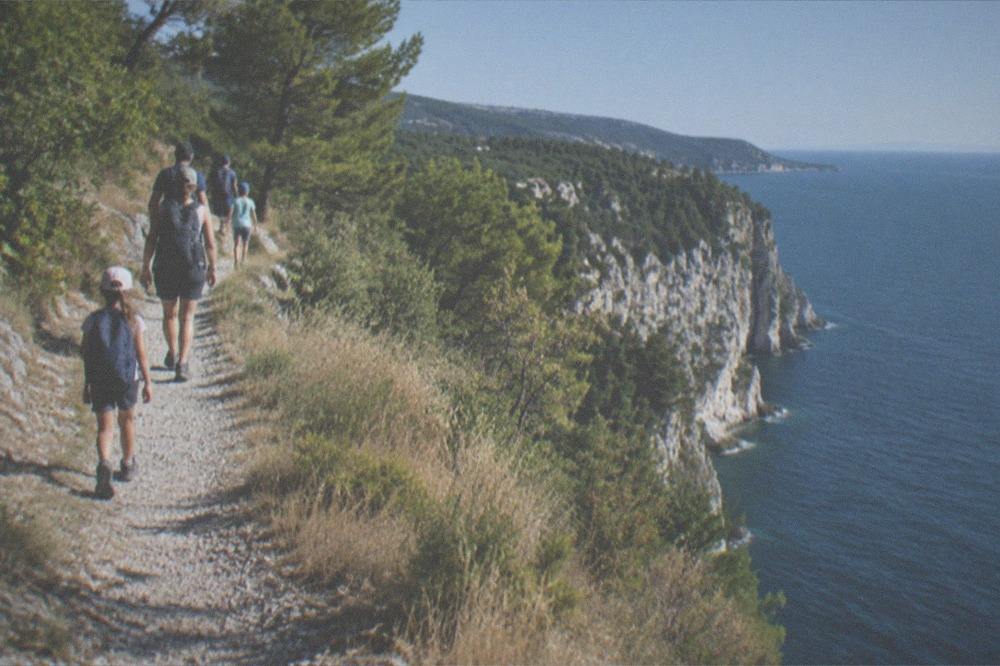
The Rilke Trail is a genuine clifftop path rather than a promenade, so it suits anyone steady on their feet in dry conditions, but it is not the right choice for pushchairs, wheelchairs or anyone uncomfortable with unprotected cliff edges, and families with small children should keep them close along the exposed sections; the flat, paved alternative in the area is the Barcola seafront back towards Trieste, and the sea-level alternative is a kayak.
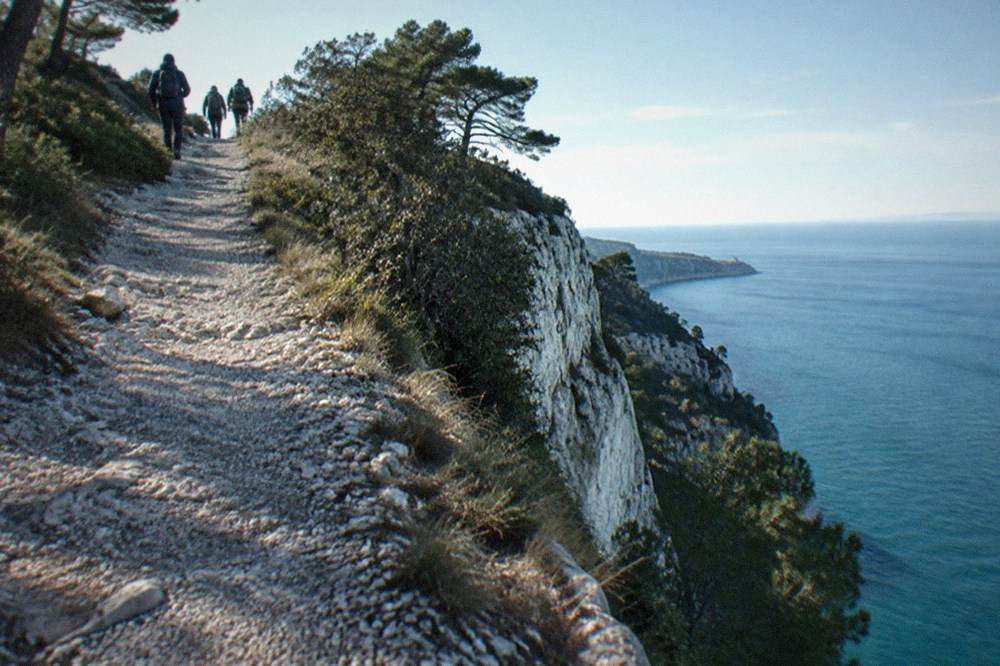
Honesty about the terrain matters more here than on most pages about this city. The path follows the top of a limestone cliff for much of its length, and the surface is a mix of stone, gravel and packed earth rather than asphalt. There is no published step count, gradient profile or accessibility rating for the trail in the sources this site uses, and this page will not invent one. What can be said is structural: it is a cliff walk, the sea is directly below significant parts of it, and the wind, when the bora blows, is stronger on an exposed headland than in the streets of the city.
For families, the practical pattern that works is the short version: start at Duino, walk as far as the old castle ruins, and turn back. That out-and-back takes in the trail's signature scenery without committing to the full stretch to Sistiana, and it ends where the castle, the town and the transport links all are. For anyone who wants the scenery without the clifftop at all, the kayak tour along the Duino coast covers the same cliffs from the water, and the Barcola seafront and the free bathing establishment at Bagno Marino La Lanterna give Trieste flat, guarded swimming with no cliff involved.
Dogs are a common sight on the trail, on a lead, as anywhere with cliff edges and livestock. In hot months carry more water than feels necessary: the Karst has almost no shade, the scrub is low, and the white limestone throws the sun back up at you. Footwear is the one piece of equipment that genuinely matters, because the stone is polished in places and slick after rain.
What Can You Combine with the Rilke Trail in One Day?
The classic combination is the Rilke Trail in the morning and Duino Castle or Miramare Castle in the afternoon, both of which sit on the same coastal corridor between the trail and Trieste; Miramare's park is free all year and the castle costs €17, Duino Castle can be visited at the trailhead itself, and the whole day can be built around a single bus corridor or a guided tour that bundles the coast and the castles.
The geography makes the pairing effortless. Duino, the trail and Miramare all sit on the same stretch of coast between Trieste and its airport, so a single day can move from a clifftop walk to a Habsburg castle without ever backtracking through the city. The order matters less than the season: in summer, walk early, castle later, swim last; in the shoulder months, castle first while the light is flat, walk after.
The paid options on this coast, with prices and ratings exactly as the operator's listings state them:
| Experience | Duration | From | Rating |
|---|---|---|---|
| Kayak, Duino coast and castles | 3 hours | $76.81 per person | 4.89 from 11 reviews |
| E-bike, old town and Miramare | 6 hours | $174.26 per person | 5 from 2 reviews |
| Panoramic city and Miramare tour | 4 hours | $129.94 per person | 4.97 from 21 reviews |
| Miramare entry with audio app | Self-paced | $20.64 per person | 4.35 from 881 reviews |
If the castle is the priority rather than the walk, the Miramare ticket options stack up like this:
| Option | Price | Notes |
|---|---|---|
| Castle entry, official site | €17.00 | Includes temporary exhibition |
| Castle entry, EU 18-25 | €7.00 | With exhibition |
| Castle entry, EU 18-25, castle only | €2.00 | Without exhibition |
| Park | Free | Open all year, hours vary by month |
| Entry ticket with audio app, listing | $20.64 | Rated 4.35 from 881 reviews |
Back in the city, the walk-heavy day pairs well with a lighter evening: the Piazza Unità d'Italia waterfront and a caffè in one of the historic bars close a Duino day better than another monument does. Trieste's coffee culture is real, but resist any per-head consumption figure you may have read elsewhere: no primary source for the widely repeated claim exists, and this site does not print numbers it cannot verify.
What Should You Know Before You Set Out on the Rilke Trail?
Before walking the Rilke Trail you should check the wind forecast, because the bora gusts over 90 km/h on 17.6 days a year on this coast and no official closure threshold exists; carry water and sun protection because the Karst has almost no shade; wear shoes with grip for stone and gravel; and if you are crossing into Slovenia afterwards, carry ID, because Italy is running temporary border checks on that land border through 18 December 2026.
The wind paragraph first, because it is the one that catches visitors out. The bora is a cold, dry north-easterly that funnels down the Karst escarpment onto this exact coast, and ARPA's station tables show gusts over 72 km/h on 49 days a year and over 90 km/h on 17.6 days. There is no published wind speed at which the trail, the Rive or the ferries formally close; the authorities assess conditions in real time rather than against a fixed cutoff, and any page that quotes one is quoting an invention. What you should do instead is read the forecast on the morning you walk, and if a strong bora is forecast, either walk the sheltered inland side of the headland or save the trail for another day.
The wind record for the Trieste molo station, month by month, tells you when the risk concentrates:
| Month | Days gusting over 72 km/h | Days gusting over 90 km/h | Record gust, km/h |
|---|---|---|---|
| February | 6.0 | 2.9 | 168 |
| March | 4.9 | 2.1 | 163 |
| November | 5.2 | 1.9 | 147 |
| January | 5.5 | 2.4 | 148 |
| June | 2.2 | 0.3 | 110 |
| July | 3.3 | 0.9 | 125 |
Two smaller things. One: the monthly record gust exceeds 110 km/h in every single month of the year, so "it is summer" is not a guarantee of calm, only a statistical lean. Two: if your day trip plans run past Duino into Slovenia, the border situation is not what older guidebooks say. Croatia adopted the euro and joined Schengen on the same day, 1 January 2023, so no currency change is needed anywhere on this coast, but Italy is running temporary checks on its land border with Slovenia, currently listed by the European Commission's register through 18 December 2026, so carry a passport or national ID card.
For the return to the city, the transport fares in the table earlier in this guide apply to the urban network, and the Opicina tram, if you fancy ending the day on the city's most photogenic line, runs from piazza Dalmazia up onto the plateau on an ordinary urban ticket. Do not believe any page that tells you the tram is suspended or that it leaves from piazza Oberdan: it was reactivated on 1 February 2025 and its current terminus is piazza Dalmazia.
If the coast has given you a taste for the Habsburg layer of this city's past, that private walk is the natural follow-up: it traces the imperial history through the streets on a two-and-a-half-hour private tour, from $143.30 per person and rated 4.86 from 21 reviews on the operator's listing. It is one of three ways this page has already flagged for turning a trail day into a full Trieste itinerary, and the trio below gathers them together.
One of the three walks above is a GuruWalk free, pay-what-you-want city walk led by a local guru, tip-based rather than priced, which is the honest way to see the city centre cheaply on the evening after the trail. The other two are paid products sold through the operator's live listings, and both can be checked for current availability and cancellation terms before you commit.
Common Questions About the Rilke Trail
Is the Rilke Trail free to walk?
Yes. The Rilke Trail is a public footpath with no ticket, no gate and no opening hours. The costs on the day are transport to Duino or Sistiana and, if you choose them, the castles: Duino Castle at the trailhead and Miramare Castle further down the coast, whose park is free all year and whose castle entry is €17 including the temporary exhibition.
Where does the Rilke Trail start and finish?
The Rilke Trail connects Duino, at the southern end beside Duino Castle, with Sistiana bay at the northern end, on the coast north of Trieste in the Friuli Venezia Giulia region of Italy. Most walkers start at Duino because the castle, the transport links and the most photographed stretch of cliff are all there.
How long does the Rilke Trail take to walk?
This site does not publish a walking time for the trail, because no verified figure for that exact walk exists in the sources it uses, and journey times are the most invented number in travel writing. Plan it as a half-day outing with stops, and check the current route information on the day-trip planner for Duino and the Rilke Trail before you set out.
Is the Rilke Trail suitable for children?
Partly. The path is a genuine clifftop walk with stone, gravel and unprotected edges along significant sections, so it suits children who walk reliably and stay close, but not pushchairs or toddlers. The popular family compromise is the short out-and-back from Duino to the old castle ruins, and the flat, paved alternative is the Barcola seafront back towards Trieste.
When is the best time of year for the Rilke Trail?
April, May, June and September, when temperatures are mild and the bora is at its least persistent. June is statistically the calmest month on this coast, with an average of 0.3 days of gusts over 90 km/h, and the sea has reached 23.1 C. November is the wettest month of the year at 109.8 mm of rain, and February is the statistical peak of the bora season.
Can you swim near the Rilke Trail?
The coves directly below the cliffs are visible from the path but are not generally reached from the trail itself. The practical swimming spots are Sistiana bay at the northern end of the trail and the Barcola seafront and Bagno Marino La Lanterna back towards Trieste. The gulf averages 25.9 C at the surface in August, and September stays warmer than June because the sea lags the air.
The Rilke Trail is the one walk on this coast that gives you the geology, the poetry and the gulf in a single stretch, and it costs nothing but a bus ticket and a pair of shoes with grip. Walk it in the calm months, pair it with Miramare's free park or a kayak below the same cliffs, and you have the best day out that Trieste's northern shoreline offers.