What Is the Best Way to Get to Trieste?
The best way to get to Trieste, Italy, compared: flying into Trieste Airport, the train from Venice, driving, and arriving by sea, with fares and border rules explained.
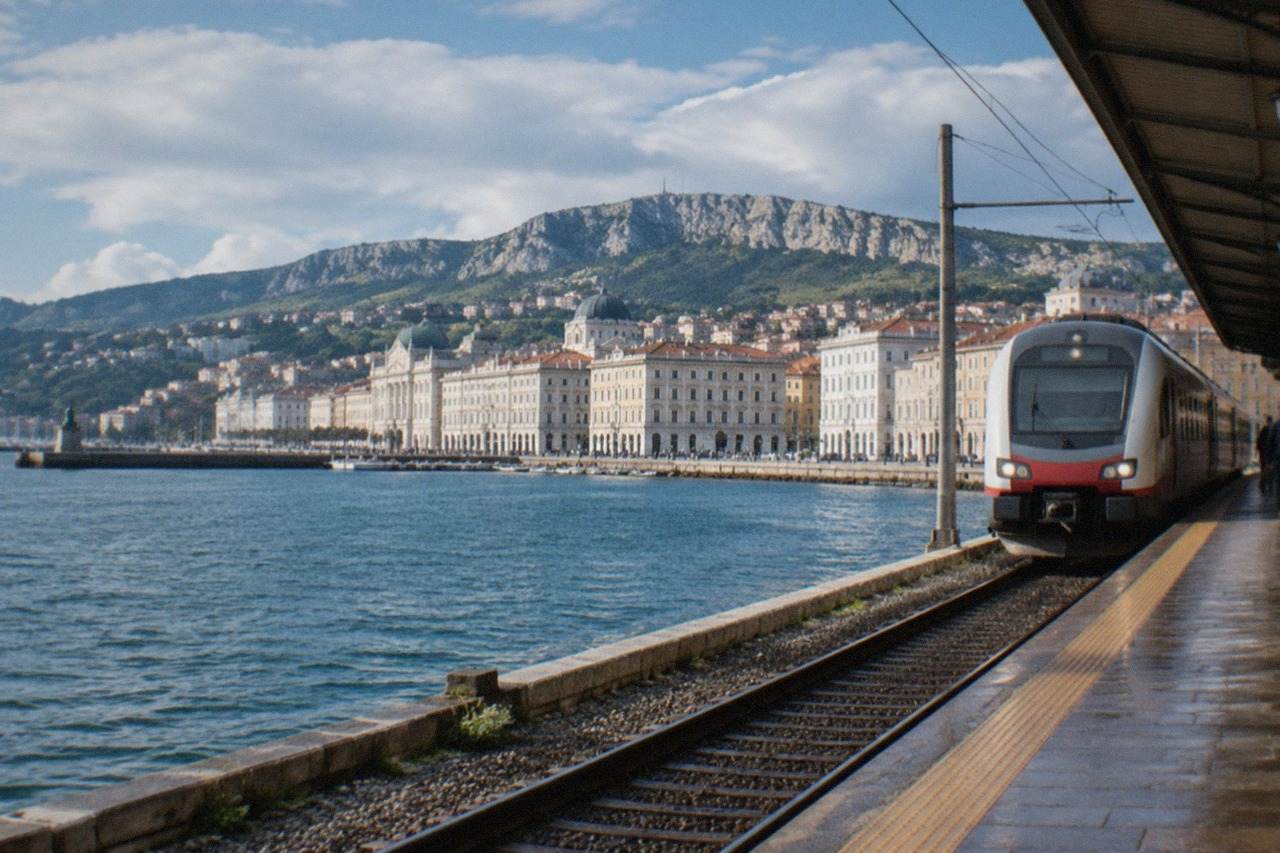
Trieste, the Adriatic port city in Friuli Venezia Giulia in the far northeast of Italy, is one of the least obvious great cities in the country to reach: it has its own small airport, a main railway station on the Venice line, a motorway that arrives from both Italy and Slovenia, and a cruise terminal within sight of Piazza Unità d'Italia. That spread of options is genuinely unusual for a city of its size, and it means the right answer is almost never a single mode. The choice turns on where you start from, whether you plan to cross into Slovenia or Croatia while you are there, and how much of the surrounding region, the Carso plateau, the Miramare coast, the Slovenian lakes, you want to reach without a car. This page compares every realistic route in, with the fares and rules that are actually printed in official sources, and it flags the two or three details most guides get wrong.
What Is the Best Way to Get to Trieste?
For most visitors the best way to get to Trieste, Italy, is to fly into Venice and take the direct train to Trieste Centrale, or to fly into Trieste's own airport at Ronchi dei Legionari when a suitable flight exists, because that airport has its own railway station linked to the terminal by a covered walkway. The city centre needs no car once you arrive, and travellers already in central Europe often do better on the rail network.
That answer is deliberately conditional, because Trieste's geography rewards different starting points differently. The city is the terminus of the Venice rail corridor, so anyone landing at Venice Marco Polo or arriving in Venice by train has a straightforward onward leg; the high-speed question and the scenic question on that stretch are covered in detail on our page about the Venice to Trieste train route. From further afield, the United States and long-haul arrivals are a different calculation, worked through on how to get to Trieste from the US: the usual verdict there is a major hub such as Venice or a connection through another European airport, since Trieste's own airport is small.
The honest summary of the comparison, using only what official sources confirm:
| Route in | What the official sources confirm | Best suited to |
|---|---|---|
| Fly into Trieste Airport (TRS) | The airport has its own railway station, joined to the terminal by a covered walkway of roughly 400 m, served by regional, Intercity and Frecciarossa trains | Anyone with a convenient connection; the fastest door-to-city option |
| Train from Venice | Trieste Centrale is on the Venice line; Trenitalia tickets are sold through its own site and station machines | Venice arrivals and Italian rail travellers |
| Car via the A4 or from Slovenia | Trieste is a motorway terminus; Italy runs temporary border checks on the Slovenia land border through 18 December 2026 | Touring the Carso, Istria and the Slovenian lakes |
| Cruise ship or ferry | The cruise terminal sits by the city centre; ferries also serve Croatian destinations seasonally | Sea arrivals, covered on our ferry routes page |
One thing the table cannot show: whichever way you arrive, the city itself is compact and walkable, so the "last mile" problem that dominates travel to bigger Italian cities barely exists here. The station, the seafront and Piazza Unità d'Italia are within an easy flat walk of one another, and the urban bus and tram network covers everything else with a standard ticket.
Is Flying Into Trieste Airport the Best Option?
Trieste Airport at Ronchi dei Legionari is the best option when a workable flight exists, because it is the only arrival point with a railway station physically attached to the terminal, linked by a covered walkway of roughly 400 metres with moving walkways, served by regional, Intercity and Frecciarossa trains. The trade-off is frequency: the airport is small, with a limited route map, and many travellers will find no direct flight at all.
The airport's own service charter, its Carta dei Servizi, is the source for the walkway and the train types, and it is worth taking seriously: very few regional Italian airports have a station this close. Regional services run onward toward Trieste, and the same station also connects toward Venice and, internationally, toward Villach and Ljubljana, which makes the airport a plausible arrival point even for people whose final destination is Slovenia. Tickets are bought through Trenitalia's site or the machines at the station and the terminal.
What the official sources do not confirm, and what no honest guide should print, is a fixed journey time or fare from the airport to Trieste Centrale. Regional timetables vary and fares change with them, so treat any "30 minutes, €5" figure you read elsewhere with suspicion. The same caution applies to the bus alternative: TPL FVG lines and long-distance coaches depart from the intermodal hub beside the terminal, but current schedules should be checked on the operator's site rather than taken from an article. The full airport walkthrough, including which airlines serve it, is on our page about which airport to fly into for Trieste.
For balance: if your home airport has no Trieste flight, the airport is not worth forcing a connection through. Venice, with its far wider route map and its direct rail link onward, usually wins for anyone crossing an ocean.
Should You Take the Train to Trieste from Venice or Beyond?
The train is the best way to get to Trieste from anywhere already on the Italian rail network, and from Venice in particular, because Trieste Centrale is the terminus of that corridor and the station sits at the edge of the centre, within walking distance of the seafront. The same station also handles regional and international services, including trains toward Slovenia and Austria.
Rail is the mode where Trieste punches above its size. The station is a terminus, which sounds like a drawback but in practice means every train that arrives is a train you can step off without worrying about direction, and the platforms open onto a street that runs straight down to the water. Cruise passengers planning the Venice-to-Trieste leg will find the station's position matters even more, and the onward connections from the city centre to the cruise port are their own conversation. The high-speed question, whether a Frecciarossa runs the Venice stretch and how it compares with the regional alternative, is answered separately on the high-speed train page, and the scenic value of the coastal stretch is worth checking before you dismiss the slower option.
Two practical notes from the official fare tables. First, once you are inside the city, Trieste Trasporti's 2026 urban tariff is cheap and simple, and the whole price list is published as a PDF on the operator's site:
| Ticket (Trieste Trasporti, urban, 2026) | Validity | Price |
|---|---|---|
| Urban single (U01) | 60 minutes | €1.50 |
| Urban single (U02) | 75 minutes | €1.85 |
| Day ticket (U24) | One day | €3.35 |
| 10 rides (U10) | Ten urban journeys | €13.50 |
| 20 rides (U20) | Twenty urban journeys | €16.65 |
Single tickets extend to 240 minutes on Sundays and public holidays, and contactless bank cards and digital wallets can be tapped directly on board via the "Eva" readers, with the system applying the cheapest applicable fare, so a visitor who never finds a ticket machine is not stranded. Second, the same urban network includes the tram de Opicina, line 2, which is running again after its long suspension and now departs from piazza Dalmazia, not piazza Oberdan as older guides claim. A standard urban ticket covers it.
If you are arriving by train and want someone else to handle the first afternoon, a guided walk is a sensible first booking: the Experience Trieste leisurely city walk is a group-rate option with strong reviews, and you can Check availability on the operator's live listing.
Do You Need a Car to Reach Trieste, Italy?
A car is not the best way to get to Trieste for most trips, because the city centre is compact, walkable and served by buses and the tram, and parking in a port city of this density is rarely the relaxing end of a drive. A car does become worthwhile if the trip is really about the region: the Carso plateau, the osmize farm outlets, the Slovenian coast and Istria, none of which are dense enough for public transport to replace driving.
The border detail is the one thing a driver must get right, and it is where most guides are wrong. Italy is running temporary internal border checks on its land borders with Slovenia from 19 June 2026 to 18 December 2026, per the European Commission's own register of reintroduced controls, so a drive from Trieste into Slovenia can involve a check and requires a passport or national ID card. This is temporary and dated, not a permanent feature of the border, and it cuts the other way too: Slovenia currently has no active controls listed with Croatia or Hungary.
Currency and Schengen membership are simpler than many articles imply. Croatia joined the Schengen area and adopted the euro on the same day, 1 January 2023, and Slovenia has been in both since 2007. Italy, Slovenia and Croatia all use the euro, so nobody driving the triangle needs to change money. What no official source provides is a wind threshold at which the coastal roads or the Rive seafront close in a bora episode, and the bora is a real feature of this coast: ARPA's station tables for the molo record an average of 17.6 days a year with a gust over 90 km/h, and the all-time peak in the series is 168.1 km/h from February 2012. Drive on a strong bora day with respect, and check the forecast rather than a supposed cutoff.
What About Arriving by Cruise Ship or Ferry?
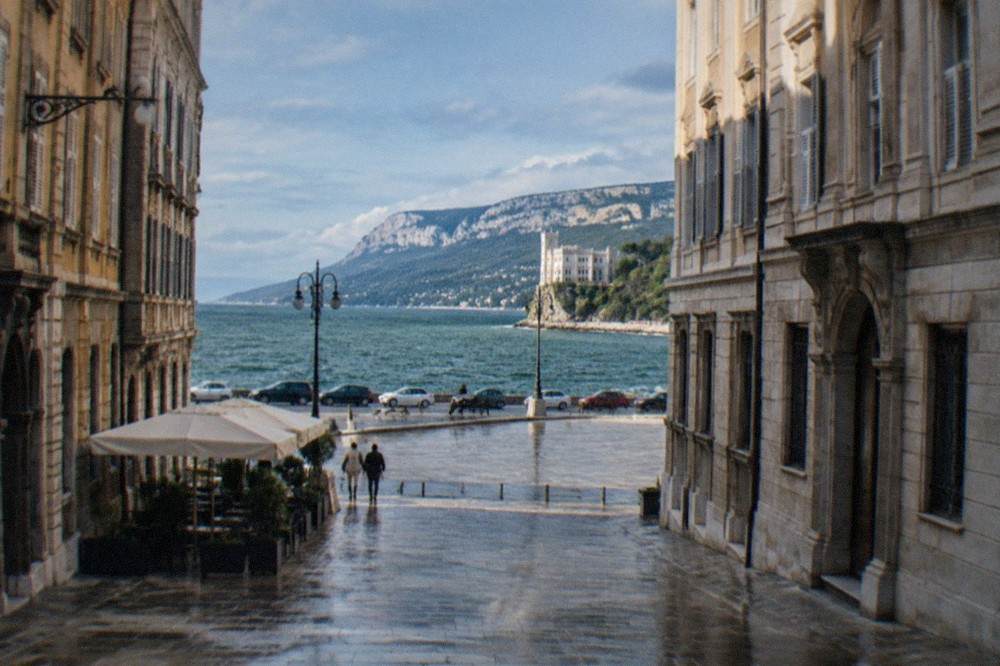
Arriving by sea is the best way to get to Trieste in one specific sense: the cruise terminal lies beside the city centre, so a ship passenger steps ashore within an easy walk of Piazza Unità d'Italia, Molo Audace and the Città Vecchia, with Trieste Centrale station close enough that the train onward to Venice is a realistic same-day plan, and no transfer or shuttle is needed to start sightseeing.
Cruise passengers get the most forgiving geography of any arrival mode. The dock is not out in an industrial port zone requiring a bus: the ships berth within sight of the main square, and the whole first-day route, the seafront, the Roman theatre viewed from the street, the San Giusto hill, is doable on foot, as our page on walking into Trieste from a cruise ship sets out. The one planning figure to hold onto is the tourist tax, charged per person per night and set by the Comune's 2026 table: €3.30 at a four-star hotel, €3.00 at a three-star, €2.30 at a two-star or a B&B Superior, down to €1.50 at campsites, capped at five consecutive nights in the same property, with everyone under 18 exempt.
| Arrival mode | Where it lands you | What the official sources say about the last leg |
|---|---|---|
| Cruise ship | Terminal beside the city centre | The centre, station and seafront are within walking distance |
| Train | Trieste Centrale, edge of the centre | Station opens onto the streets leading down to the seafront |
| Plane (TRS) | Ronchi dei Legionari, with attached station | Covered walkway of roughly 400 m links terminal and platforms |
| Car | City terminus of the A4 corridor | Temporary Slovenia border checks run through 18 December 2026 |
Ferries are a smaller part of the picture but a real one: seasonal services connect Trieste with Croatian ports across the top of the Adriatic, and the details, destinations and the honest caveats about schedules are on our Trieste to Croatia ferry page. The short version is that the ferry is a pleasure-boat option for the Istrian coast, not a commuter route, and its timetables are seasonal enough that they must be checked for the specific travel week.
How Do You Get Around Once You Arrive?
Once you arrive in Trieste you mostly walk, because the centre is flat, compact and strung along the seafront between the station and Piazza Unità d'Italia, and the parts that are not walkable, the Opicina hill, the Miramare coast, Barcola, are covered by the urban network with a €1.50 single or a €3.35 day ticket, tap-to-pay on board, and the reactivated tram line 2 running from piazza Dalmazia.
The tram deserves its own sentence because so much published information about it is stale. It was reactivated on 1 February 2025 after the long suspension that followed a 2016 accident, and Trieste Trasporti's line-2 page carries a current timetable dated from July 2026 running between piazza Dalmazia and Opicina. Any guide that tells you the tram is suspended, or that it leaves from piazza Oberdan, has not checked the operator's own site, and you should treat the rest of that guide with matching caution.
For the day you want a structure rather than a route, a food walk is the most efficient single booking in the city: the Trieste guided foodie walking tour covers the street-food side of the city's mixed cuisine, from $71.08 per person with a strong rating from 264 reviews on the operator's listing. And if the weather turns, note that Trieste's wettest month is November, not a summer month: ARPA's station normals put November at 109.8 mm of rain against July's 53.8 mm, so a summer arrival is a drier bet than most of the Mediterranean coast suggests.
Common Questions About Getting to Trieste
What is the best way to get to Trieste?
Fly into Trieste Airport when a suitable flight exists, since its attached railway station makes the onward leg simple; otherwise fly to Venice and take the direct train to Trieste Centrale. A car only pays off if the trip is really about touring the Carso, the Slovenian coast or Istria.
Is there a train from Trieste Airport to the city centre?
Yes. The airport has its own station, Trieste Airport, linked to the terminal by a covered walkway of roughly 400 metres, served by regional, Intercity and Frecciarossa trains. Buy tickets via Trenitalia's site or the machines at the station; no fixed journey time or fare is published in the official sources, so check the operator for your travel date.
Do I need a passport to visit Slovenia from Trieste?
Carry one. Italy is running temporary internal border checks on its land borders with Slovenia from 19 June 2026 to 18 December 2026, per the European Commission's register, so a passport or national ID card is required even though both countries are in Schengen.
Does the Opicina tram run from Piazza Oberdan?
No. The tram de Opicina, urban line 2, is running again since 1 February 2025, but its city terminus is piazza Dalmazia, with the published route running from there up to Opicina. A standard urban ticket is valid and contactless cards can be tapped on board.
Can you walk into Trieste from a cruise ship?
Yes, and that is the main advantage of arriving by sea: the cruise terminal sits beside the city centre, so Piazza Unità d'Italia, the seafront and Trieste Centrale station are all within an easy walk of the gangway.
Whichever route you choose, the city at the end of it rewards the decision: for what to do with the days after arrival, our how many days you need in Trieste page is the natural next stop, and Trieste Travel Guide covers the rest of the planning in depth.